How much Social Security will I get?
Short answer
It depends on your pay over your best 35 working years and the age you claim. In 2026 the most a worker claiming at full retirement age could get was $4,152 a month. SSA estimates the average retired worker gets about $2,095 a month before the January 2027 raise. Your real number is in your my Social Security account at ssa.gov.
- What it is
- Your Social Security retirement check is based on what you earned over your working life (up to a yearly limit, $184,500 in 2026) and the age you start, from 62 to 70.
- Who it helps
- Anyone in the US who wants a ballpark number before looking up the official one.
- When to use it, and the catch
- Use this for a quick idea, then sign in to my Social Security for your real estimate. The catch: this rough version cannot see your actual earnings record, so missing years or very uneven pay can change the number a lot.
Example: Maria averaged about $60,000 a year over 35 years. Her full benefit at 67 works out to about $2,345 a month. Claiming at 62 would pay about $1,642, and waiting to 70 about $2,908.
WisePlan Wealth is an on-device retirement spending planner (no account, data stays on your phone); it is not a tax filer, not an official SSA calculator, and does not give your official benefit amount.
Rough Social Security calculator
Runs in your browser. Nothing is saved or sent.
See your whole plan
A rough estimate for learning, not financial advice and not SSA’s calculator. Get your real estimate in your my Social Security account at ssa.gov.
Table by claiming age
| Claim at | Share of full benefit | Monthly | Yearly |
|---|
How this is calculated / assumptions
- Monthly average: your yearly pay (up to the 2026 limit of $184,500) × your years (35 at most) ÷ 35 ÷ 12. Missing years count as zero, as they do at SSA. Today’s dollars stand in for SSA’s wage-adjusted pay.
- Full benefit at 67, with SSA’s 2026 amounts for people who turn 62 in 2026: 90% of the first $1,286, plus 32% of the part up to $7,749, plus 15% of the rest, rounded down to the dime. Capped at the 2026 maximum of $4,152 unless you enter your own monthly average.
- Claiming age: assumes a full retirement age of 67 (born 1960 or later). Before 67: 5/9 of 1% less per month for the first 36 months, then 5/12 of 1% per month (70% at 62). After 67: 2/3 of 1% more per month, 8% a year (124% at 70). Result rounded down to the dollar.
- Not included: your actual earnings record, yearly raises after you claim, the earnings test, tax on Social Security, Medicare premiums, and benefits based on a spouse’s record.
Sources
Sources (checked October 21, 2026, ssa.gov): 2026 bend points $1,286 and $7,749, for people who turn 62 in 2026 from SSA’s Benefit formula bend points; the 90% / 32% / 15% formula, rounded down to the dime from SSA’s Primary Insurance Amount; up to 35 years of wage-adjusted pay make the monthly average from SSA’s Social Security benefit amounts; 2026 pay limit $184,500 from SSA’s Contribution and benefit base; 2026 maximum $4,152 at full retirement age, $2,969 at 62, $5,181 at 70 (dated January 2, 2026) from SSA’s What is the maximum Social Security retirement benefit payable?; 3.6% raise for 2027, average retired worker about $2,095 before and $2,170 after, 2026 earnings test limit $24,480 from SSA’s 2027 COLA fact sheet; 2.8% raise paid from January 2026 from SSA’s Cost-of-living adjustments; 40 credits; $1,890 per credit in 2026 from SSA’s Social Security credits; full retirement age 67 for 1960 or later, early reduction from SSA’s Retirement benefits by year of birth; 8% a year after full retirement age, up to 70 from SSA’s Delayed retirement credits. Your own estimate: my Social Security.
FAQ
- How much Social Security will I get?
- It depends on your pay over your best 35 working years and the age you claim. In 2026 the most a worker claiming at full retirement age could get was $4,152 a month ($2,969 at 62 and $5,181 at 70). SSA estimates the average retired worker gets about $2,095 a month before the January 2027 raise. Your own estimate is in your my Social Security account at ssa.gov.
- How does Social Security work out my benefit?
- SSA adjusts your past pay for wage growth, takes your best 35 years and turns them into a monthly average. For people who turn 62 in 2026, your full benefit is 90% of the first $1,286 of that average, plus 32% of the part up to $7,749, plus 15% of the part above that. Pay above the yearly limit ($184,500 in 2026) does not count.
- How much less do I get if I claim at 62?
- If your full retirement age is 67 (born 1960 or later), claiming at 62 pays 70% of your full benefit for life. Each year you wait past 67 adds 8%, up to 124% at 70. Nothing more is added after 70. More: when to take Social Security and find your full retirement age.
- How many years do I need to work to get Social Security?
- You need 40 work credits, which is about 10 years of work. In 2026 you earn one credit for every $1,890 of pay, up to four a year. The amount is still based on 35 years, so fewer than 35 working years means some zero years are counted in your average. See Social Security credits for a credits calculator.
- Does Social Security go up each year?
- Yes, with a yearly cost-of-living raise. The raise that started with January 2026 payments was 2.8%, and SSA announced a 3.6% raise starting with January 2027 payments. More: the Social Security raise for 2027. For the day it arrives, see Social Security payment dates.
- Can I work and collect Social Security?
- Yes. If you claim before full retirement age and earn more than $24,480 in 2026, SSA holds back $1 for every $2 over that limit. The held-back months are added back once you reach full retirement age. More: the Social Security earnings test.
Full guide
Social Security publishes a maximum and an average, but your check is built from your own earnings record and the age you claim. This guide explains what drives the number, with year-labelled SSA figures, and shows where to get your official estimate. Related: when to take Social Security, full retirement age, tax on Social Security and the earnings test.
What drives your Social Security amount
- Your pay over 35 years. SSA adjusts each year’s pay for wage growth, picks your best 35 years and works out a monthly average. Years you did not work count as zero.
- The yearly pay limit. Only pay up to the limit counts ($184,500 in 2026; $192,300 in 2027).
- The age you claim. From 62 to 70. Your full retirement age is 67 if you were born in 1960 or later.
Published maximum and average (labelled years)
| Figure | Monthly amount | Label / period |
|---|---|---|
| Maximum, claiming at full retirement age | $4,152 | 2026 |
| Maximum, claiming at 62 | $2,969 | 2026 |
| Maximum, claiming at 70 | $5,181 | 2026 |
| Average retired worker | about $2,095 | SSA estimate before the January 2027 raise |
| Average retired worker | about $2,170 | SSA estimate after the 3.6% January 2027 raise |
The maximums are for someone who earned at or above the pay limit every year from age 22. Most people get less. Sources: SSA’s maximum benefit answer (January 2, 2026) and the 2027 COLA fact sheet.
How the formula works (2026 amounts)
For people who turn 62 in 2026, SSA’s full benefit is 90% of the first $1,286 of your monthly average, plus 32% of the part from $1,286 to $7,749, plus 15% of anything above $7,749 (SSA bend points). The first dollars count the most, so lower earners get back a bigger share of their pay. These amounts go up each year with wages; for people who turn 62 in 2027 they are $1,340 and $8,077.
How to get your official estimate
- Sign in or create an account at my Social Security on ssa.gov.
- Open your Social Security Statement. It shows your estimated monthly check at 62, at full retirement age and at 70.
- Check your earnings record year by year. Missing or wrong years lower your check, and you can ask SSA to fix them.
Claiming age changes your check for life
With a full retirement age of 67, claiming at 62 pays 70% of your full benefit and waiting until 70 pays 124%. The choice also depends on your health, other income and whether you can cover your spending while you wait. See when to take Social Security for a side-by-side calculator.
Turn your Social Security number into a spending number
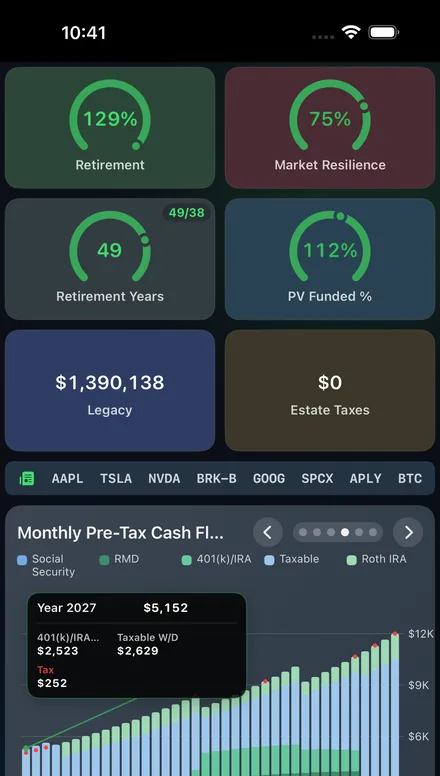
Knowing your Social Security check is step one. The bigger question is how much you can spend. Instead of checking whether your plan works with a budget you had in mind, see how much you can actually afford to spend each month in retirement, tuned for your Go-Go, Slo-Go and No-Go years. WisePlan Wealth takes your Social Security estimate, pensions, and your 401(k), IRA and other savings, and finds the most you can afford to spend each month.
WisePlan Wealth is an on-device retirement spending planner (no account, data stays on your phone); it is not a tax filer, not an official SSA calculator, and does not give your official benefit amount. Free to start.
This is general information, not financial, tax, investment or legal advice. Social Security rules and amounts are set by law and run by the Social Security Administration, and they can change. Confirm your estimate in your my Social Security account before you claim. Page dated October 21, 2026.
🇨🇦 In Canada? See how much CPP will I get.