Retiring at 61 on $1.14 million with no pension in Indiana
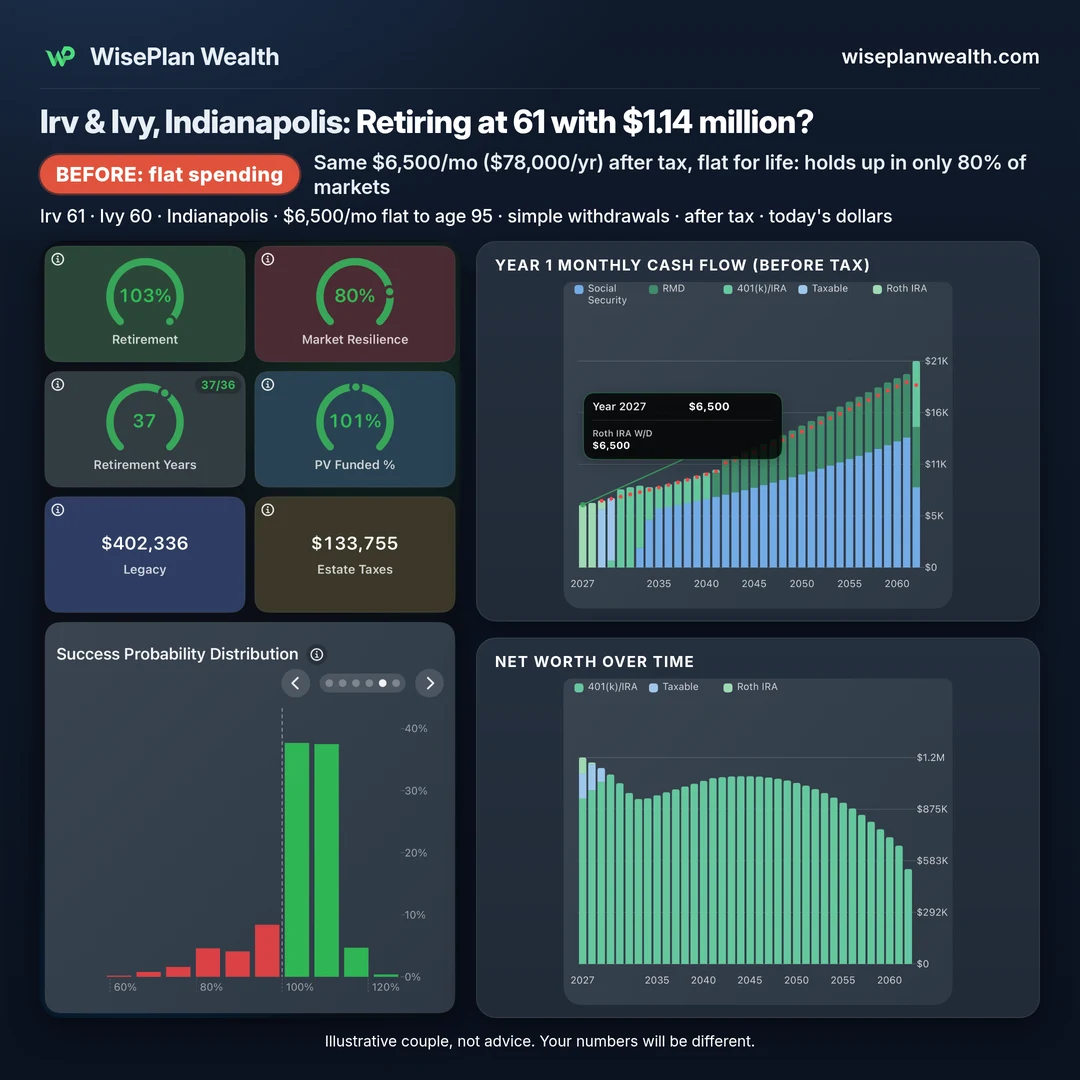
Short answer: Yes, they can stop at 61 and 60. About $1.14 million with no pension can support about $6,500 a month ($78,000 a year) after tax. The simple way pays for everything from the Roth IRAs first (the full $6,500 a month in 2027), so the 401(k)s sit and grow and come out later on top of Social Security and required withdrawals, at a higher tax rate. Drawing from the 401(k)s and the taxable account in the six low-income years before Social Security starts at 67, keeping the Roth IRAs growing tax-free, and easing off a bit at 75 and 85, takes the same $6,500 from 80% to 92%, with about $1,342,000 left at 95 instead of $402,000.
A sample couple in Indianapolis, Indiana, run in the WisePlan Wealth app. All amounts are after tax, in today's dollars.
The situation
Irv is 60 and Ivy is 59. They live in Indianapolis, Indiana. Both plan to stop working in mid-2027, when Irv is 61 and Ivy is 60. Neither has a workplace pension.
Here's what they have: 401(k)/IRAs of $600,000 and $250,000, Roth IRAs of $90,000 and $70,000, and $130,000 in a taxable account, about $1.14 million in all. They're saving about $2,500 a month until they stop. Social Security (about $2,750 and $1,850 a month) starts at 67.
The worry
Their question is simple: can they stop at 61 and 60 with about $1.14 million and no pension? The first six years, until Irv's Social Security starts at 67, have to come from savings alone. Instead of checking whether a budget they had in mind works, they want to know how much they can actually afford to spend.
What the numbers say
All spending below is after tax, in today's dollars, with the plan running to 95. The plan gets tested against many historical market runs, the good starts and the bad ones.
Step 1: Spend the same amount every year, no matter what. $6,500 a month, flat, for life, taking money out the simple way. It holds up in 80% of historical markets, below the 90% bar, with about $402,000 left at 95 in an average market.
Step 2: Same starting amount, but a more flexible plan, with withdrawals timed to keep tax low:
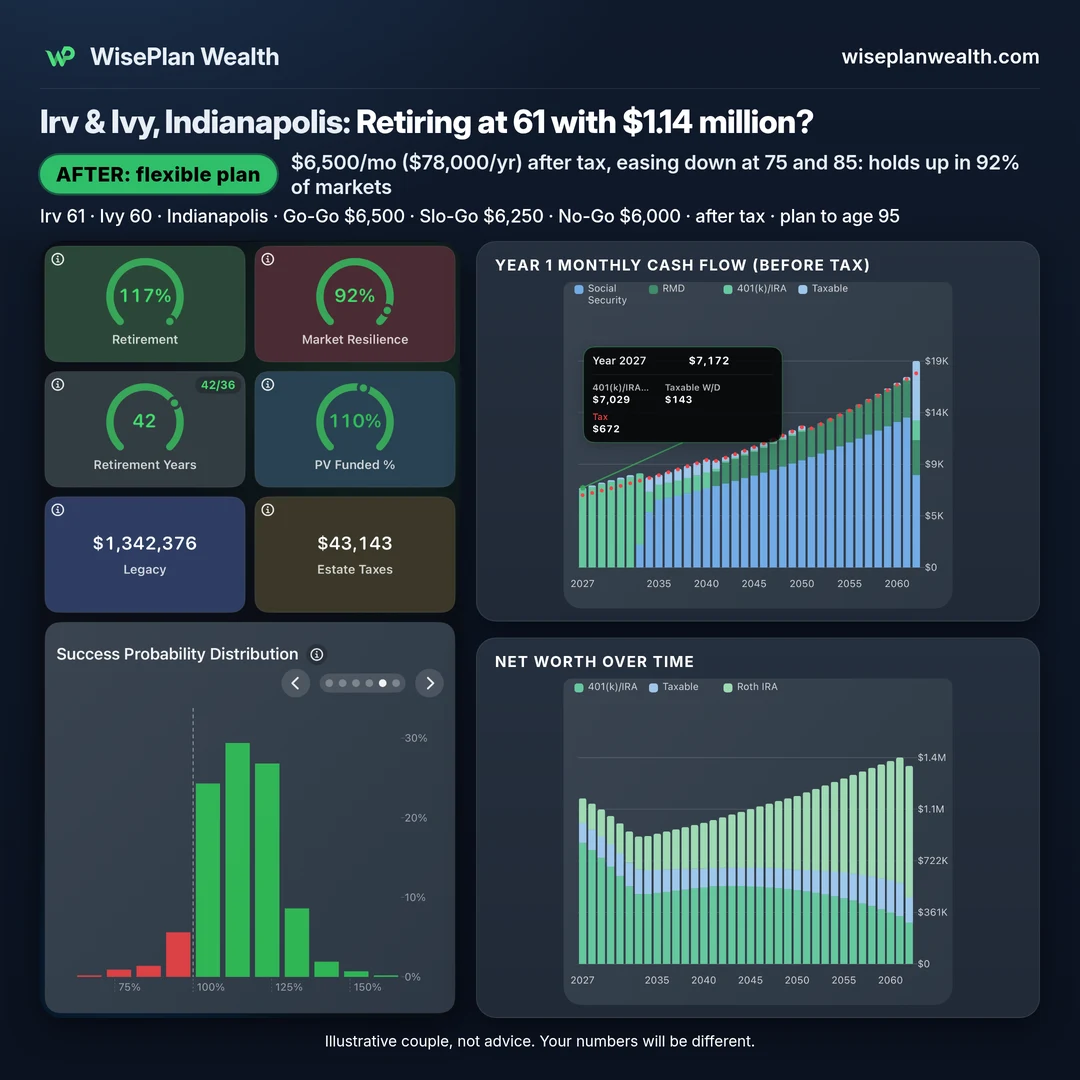
- $6,500 a month in the earlier years
- $6,250 a month from 75 to 84 (the Slo-Go years)
- $6,000 a month from 85 on
To find that $6,500, we pushed spending as high as the plan allows ($7,200, which holds up in only 49% of markets), then brought it down until the plan held up in more than 90%.
That plan holds up in 92% of historical markets, with about $1,342,000 left at 95 in an average market. In 2027, their first year retired, they'd draw about $7,172 a month before tax: $7,029 from the 401(k)s/IRAs and $143 from the taxable account. About $672 goes to tax, which leaves the $6,500.
The takeaway
Yes, they can stop at 61 and 60. About $1.14 million with no pension can support about $6,500 a month ($78,000 a year) after tax. The simple way pays for everything from the Roth IRAs first (the full $6,500 a month in 2027), so the 401(k)s sit and grow and come out later on top of Social Security and required withdrawals, at a higher tax rate. Drawing from the 401(k)s and the taxable account in the six low-income years before Social Security starts at 67, keeping the Roth IRAs growing tax-free, and easing off a bit at 75 and 85, takes the same $6,500 from 80% to 92%, with about $1,342,000 left at 95 instead of $402,000.
See the answer, year by year
Loading the interactive plan…
Try the free calculators
- How much can I spend in retirement? (US)
- When to take Social Security
- Tax on Social Security
- Required minimum distributions (RMD)
- 401(k) vs IRA
- Roth conversion
- Retirement income gap (US)
- Tax in retirement (US)
More retirement stories
- Retiring at 57 on $1.45 million in North Carolina: can they spend $10,000 a month?
- Retiring at 55 on $1.5 million in Oregon
- Retiring at 60 with a public pension in Ohio: how much can they spend?
- Retiring at 58 on $1.6 million in Tennessee
- All USA stories
Run your own numbers
The free calculators above each answer one piece. For the full picture, with how much you can safely spend, which account to draw from first and when to start Social Security, download WisePlan Wealth.
This couple is an example, not real people. The numbers come from a real run of the WisePlan Wealth app with its default return and inflation assumptions. This is an example, not advice, and your numbers will be different.