Basic personal amount calculator (2026)
Short answer
Almost everyone can earn some income without paying federal tax. For 2026 the basic personal amount is $16,452, which saves up to $2,303 of federal tax; it shrinks only if your net income is over $181,440.
- What it is
- A federal tax credit everyone gets, so the first part of your income is, in effect, tax-free. Provinces have their own basic amounts.
- Who it helps
- Every Canadian resident who files a tax return, including retirees and students.
- When to use it, and the catch
- It is claimed for you on your return (line 30000) and on Form TD1 at work or from your pension. The catch: it only lowers tax you owe, so it is not paid out if you owe none, and high earners get less.
Example: Aisha earns $60,000. Her basic personal amount is $16,452, which cuts her federal tax by about $2,303 for 2026, about $192 a month.
Basic personal amount calculator
Runs in your browser. Nothing is saved or sent.
Will your net worth last?
How much you can spend monthly
An estimate for education, not tax advice. Your return works out the exact amount.
Table by income
| Net income | Basic personal amount | Federal tax saved |
|---|
How this is calculated / assumptions
- 2026: $16,452 if net income is $181,440 or less; $14,829 at $258,482 or more; in between it drops in a straight line (CRA Form TD1-WS).
- Tax saved = the amount × 14%, the lowest federal rate for 2026. It is non-refundable: it cannot take your federal tax below zero.
- Provincial and territorial basic amounts are separate and not included.
- For 2025 returns, CRA’s line 30000 amounts are $16,129 (net income $177,882 or less) down to $14,538 (over $253,414).
Sources
Sources (checked 29 September 2026): 2026 amounts from CRA’s Form TD1 2026 and Form TD1-WS 2026; 2025 amounts from CRA’s Line 30000 – Basic personal amount (tax year 2025); the 14% lowest federal rate from CRA’s Current year tax rates and income brackets (2026).
FAQ
- What is the basic personal amount?
- A federal non-refundable tax credit that every resident can claim, so the first part of your income is, in effect, free of federal tax. For 2026 it is $16,452 for most people.
- How much tax does the basic personal amount save in 2026?
- At the 14% lowest federal rate for 2026, the full $16,452 lowers your federal tax by about $2,303. It cannot take your federal tax below zero.
- Who gets a smaller basic personal amount?
- People with net income over $181,440 in 2026. It shrinks gradually to $14,829 for net income of $258,482 or more.
Full guide
This guide summarises CRA’s Line 30000 – Basic personal amount (tax year 2025), Form TD1 2026, Form TD1-WS 2026, and CRA’s Payroll Deductions Formulas (T4127, 122nd edition, effective January 1, 2026). Related: Form TD1, federal tax brackets, spouse amount, eligible dependant amount, age amount, Canada caregiver amount, and CRA My Account.
What the basic personal amount is
CRA: the basic personal amount is a non-refundable tax credit that allows you to earn a minimum amount of income before having to pay federal income tax. On the federal return it is claimed on line 30000. Non-refundable means it can reduce federal tax payable; it is not a cash payment, refundable benefit, or a published “tax refund” dollar on its own.
Generally you can claim it if you were a resident of Canada or a deemed resident of Canada for the year. CRA notes that special rules apply if you were bankrupt or moved to Canada or from Canada during the tax year—contact the CRA for those situations. The federal amount you can claim depends on your net income for the year (line 23600). Enter the federal amount on line 30000. Review slips and your return in CRA My Account; results also appear on your notice of assessment.
Federal amounts for 2025 (line 30000)
CRA’s line 30000 page (tax year 2025). If your net income (line 23600) is:
- $177,882 or less — claim $16,129 on line 30000
- more than $253,414 — claim $14,538 on line 30000
- otherwise — use the Federal Worksheet (5000-D1) to calculate your claim
These are the federal basic personal amounts you enter—not a cash payment. CRA does not publish a single “this credit is worth $X of tax” figure on the line 30000 page, so no fabricated tax-savings example is shown here. The gap between the maximum and the high-income floor is the income-dependent supplement that phases out between those thresholds; CRA’s worksheet does the arithmetic when you are in between.
Federal amounts for 2026 (TD1 / TD1-WS / T4127)
As of this page’s date, CRA’s public line 30000 web page is still labelled tax year 2025. For 2026 payroll and withholding, CRA publishes:
- Form TD1 2026: every resident of Canada can enter a basic personal amount of $16,452. If estimated net income from all sources will be greater than $181,440 and you enter $16,452, you may have an amount owing at year-end; you may instead calculate a partial claim on Form TD1-WS.
- Form TD1-WS 2026: if estimated net income is more than $181,440, calculate the partial claim; the worksheet directs you to enter $14,829 when the phase-down calculation hits zero or negative (base floor $14,829; applicable amount $1,623; income threshold $181,440; divisor $77,042).
- T4127 (122nd edition, effective January 1, 2026) Federal Basic Personal Amount (BPAF) formula: where net income ≤ $181,440, BPAF = $16,452; where $181,440 < net income < $258,482, BPAF = $16,452 − (net income − $181,440) × ($1,623 / $77,042); where net income ≥ $258,482, BPAF = $14,829.
| Source / year | Maximum federal BPA | Full amount if net income is | Minimum / high-income amount |
|---|---|---|---|
| 2025 (line 30000) | $16,129 | $177,882 or less | $14,538 if more than $253,414 |
| 2026 (TD1 / TD1-WS / T4127) | $16,452 | $181,440 or less | $14,829 if $258,482 or more |
Use the figures that match the tax year you are filing or the TD1 year your employer uses. When you file the 2026 T1, use that year’s Income Tax Package amounts on Canada.ca—not only TD1 withholding figures. Confirm Canada.ca wording when you file.
How TD1 / payroll claims relate
Form TD1, Personal Tax Credits Return is what your employer or payer uses to estimate federal income tax to deduct from salary, wages, commissions, pensions, EI benefits, or other remuneration. The basic personal amount is usually line 1 on the federal TD1. If you do not fill out a TD1, CRA’s form instructions say deductions include only the basic personal amount estimated from the income that employer pays you.
That withholding is an estimate toward your annual tax—not your final bill. Year-end tax still depends on total income, the federal tax brackets, non-refundable credits on the T1 (including line 30000), and other CRA rules. Claiming the maximum on Form TD1 when your full-year net income will be above the published threshold can leave too little tax deducted during the year—CRA’s TD1 2026 wording flags that risk explicitly. For a fuller TD1 walkthrough (federal vs provincial forms, multi-employer rules, when to file a new form), see Form TD1.
How income-dependent BPA still works
For both 2025 and 2026, CRA still publishes a two-tier federal BPA: a higher maximum at or below a published income threshold, a lower floor at or above a higher threshold, and a worksheet or payroll formula in between. Related personal credits on the same return (if you qualify) include the spouse or common-law partner amount, amount for an eligible dependant, age amount (line 30100), and Canada caregiver amount. Those are separate lines with their own CRA rules—not substitutes for line 30000. Marginal rates themselves are on the federal tax brackets page.
Provincial or territorial basic amounts — soft pointer only
CRA’s line 30000 page also points to provincial and territorial basic personal amounts on Form 428 (generally line 58040), which vary by jurisdiction. This guide does not reprint those Form 428 dollar tables. For context on provincial tax structure (not BPA tables), see guides such as Alberta, Ontario, British Columbia, Quebec, and other provincial brackets pages on this site. Use CRA’s line 30000 page, your province’s Form 428, or Revenu Québec guidance if you live in Quebec.
Keep net income beside the credits you claim
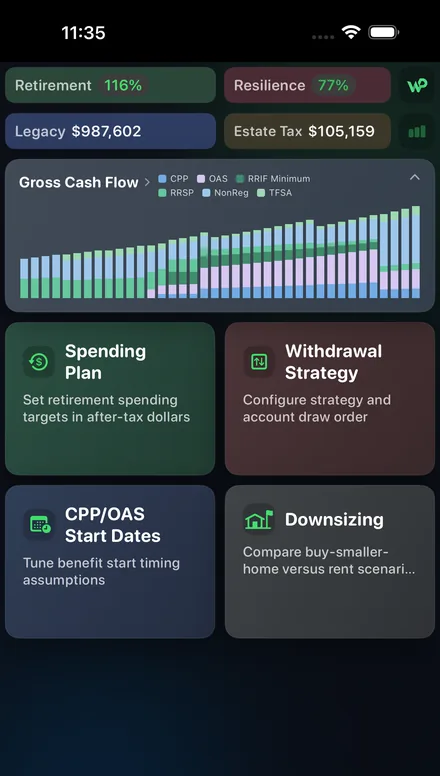
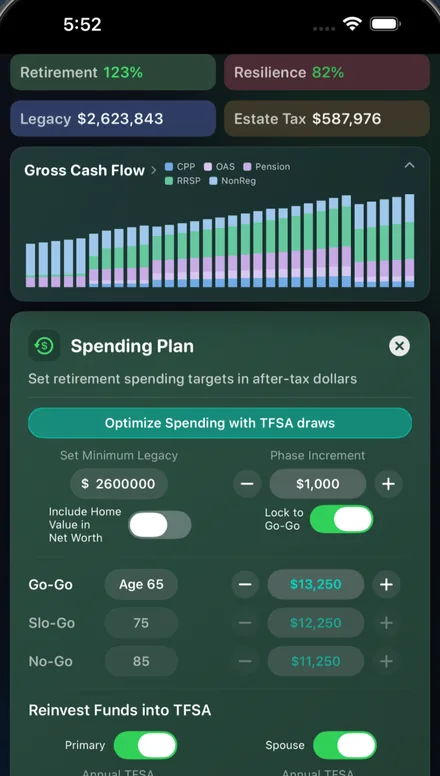
WisePlan Wealth is an on-device Canada retirement planner. If you model RRSP, TFSA, CPP, OAS, and other cash flows, put those years beside net income (line 23600)—the same figure that can reduce the two-tier basic personal amount—and next to guides on Form TD1, federal tax brackets, the spouse amount, eligible dependant amount, age amount, Canada caregiver amount, and CRA My Account. Free to start. No account. Data stays on the device. Not a substitute for CRA forms or a tax professional.
Source: Canada.ca, checked Oct 2026.
This is general information, not financial, tax, investment, legal, or accounting advice. Basic personal amount rules and figures are set by legislation and administered by the CRA and can change. Confirm eligibility, line 30000, federal amounts for the tax year you are filing, Form TD1, and any provincial Form 428 amount on Canada.ca or with a qualified professional. Page dated 4 September 2026.